Mudda System Architecture
Microservice Overview of the AI-Powered Civic Engagement Platform
Architecture Diagram
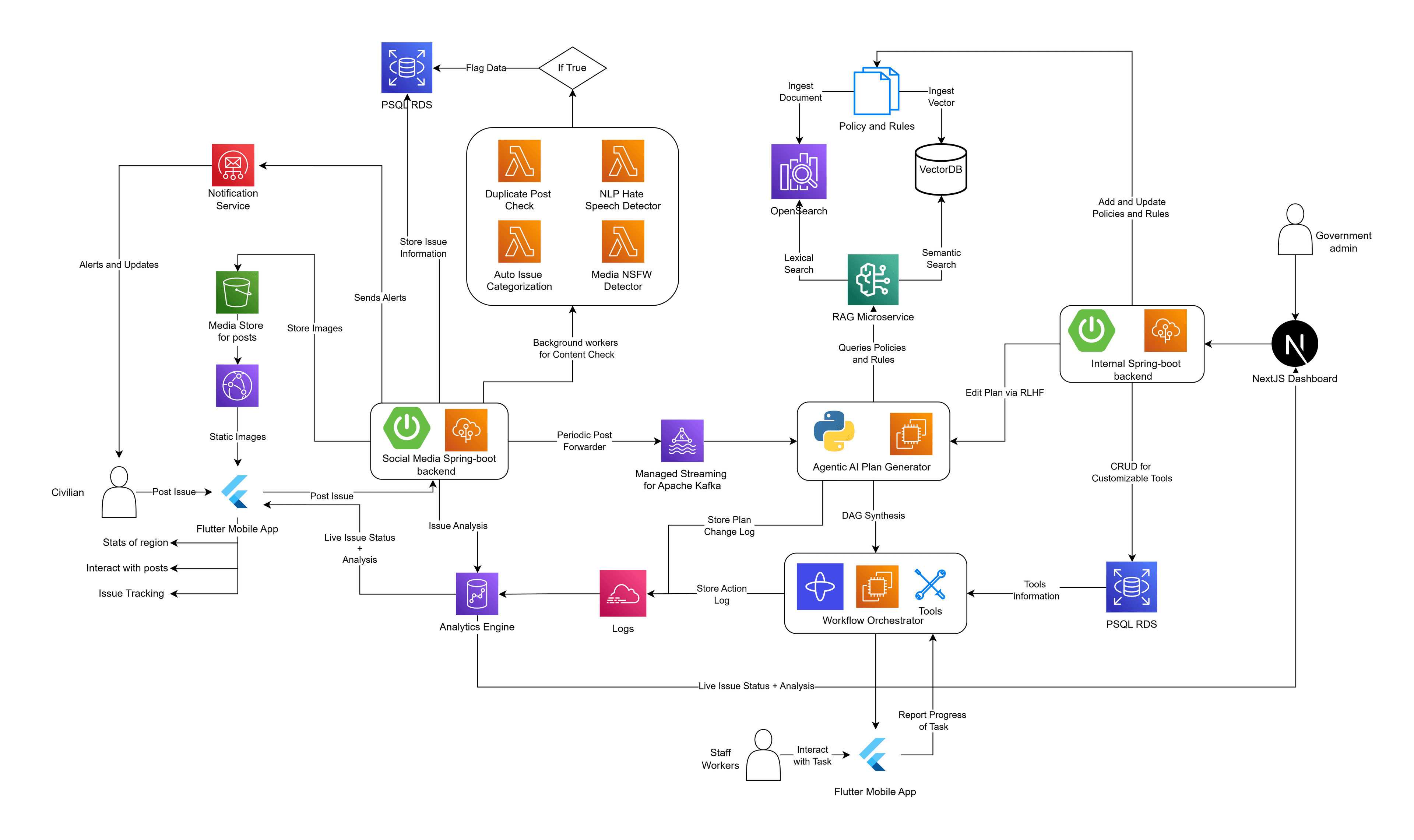
High-Level System Architecture
Microservice Grid
All components collaborate to deliver transparent and trusted civic workflows.
Hate Speech Detector
NLP microservice that flags hate speech, toxicity, abusive content, and policy violations.
Post Duplication Detector
AI service that identifies similar or duplicate issues using embedding-based semantic similarity.
AQI, Pothole Detection, Disaster Prone Areas Detection, etc. AI Models
CV + Sensor-based detectors for environment and infrastructure issues.
SLMs and AI fine-tuned background workers
Background worker service utilizing small language models and fine-tuned AI models deployed on Azure. This covers processes like automatic department routing, post severity score detection, automatic issue categorization, image scenic understanding, NSFW detection, Hate Speech Detection and Duplicate Post Detection (Clustering into a master incident)
AWS S3
Stores user-uploaded images, videos, and documents.
PostgreSQL (PSQL)
Main relational database for structured application data.
Qdrant Vector Database
Stores embeddings for semantic search, deduplication, and similarity matching.
Elastic Search
Stores data for full-text search, lexical-search, geo-search and analytics.
Tech Stack
Core technologies powering the Mudda platform

Spring Boot

Flutter

Next.js

Temporal.io

LangChain + LangSmith

Hugging Face

Qdrant Vector DB

PostgreSQL

AWS Ecosystem